The Project: RadioShack App (iOS & Android)
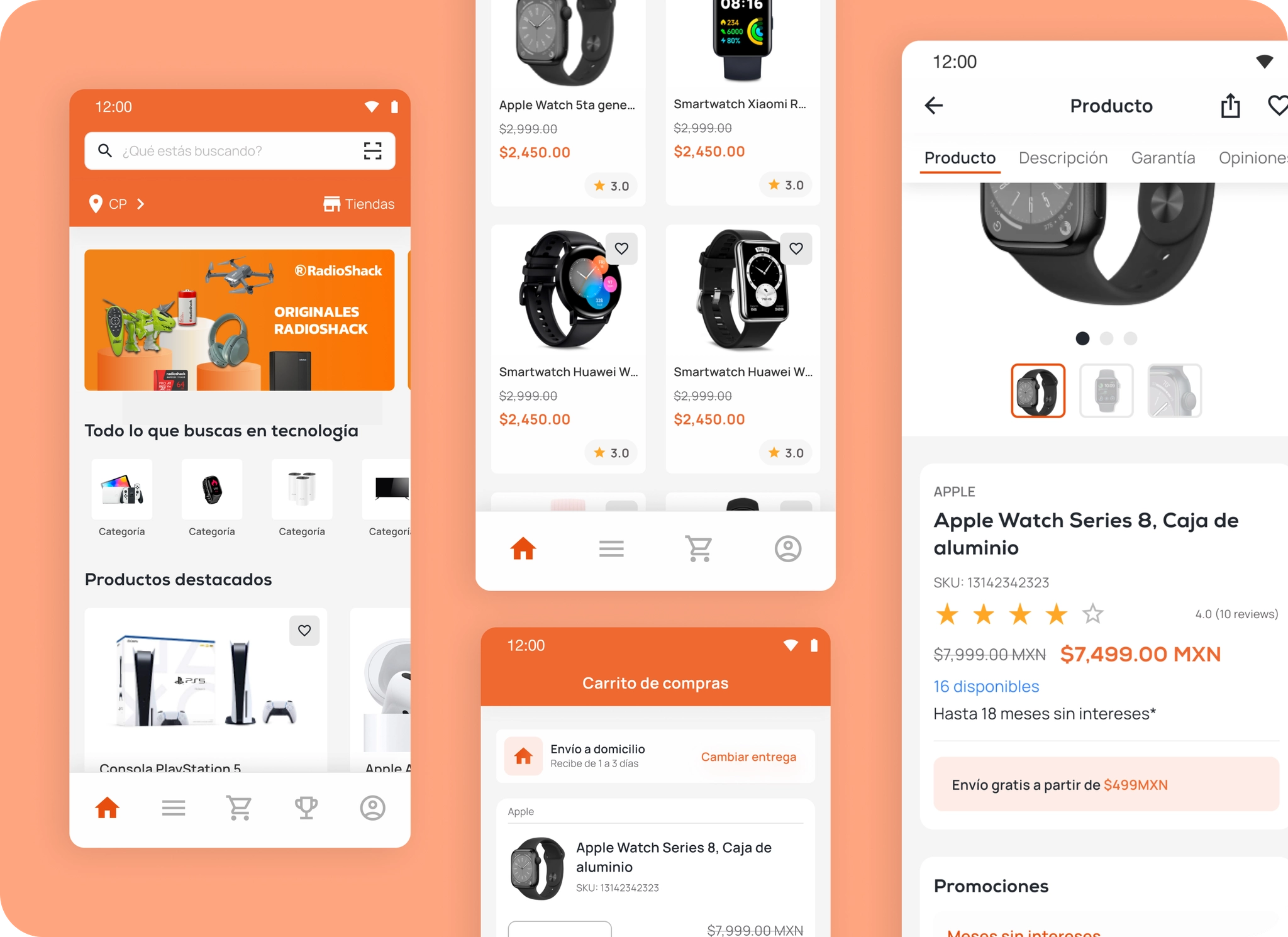
In the case of RadioShack, my responsibility was to lead the UX/UI design for the launch of their native mobile application in Mexico. The challenge was not to create a brand, but to professionalize its digital presence on mobile devices. Until then, the brand operated with a 'Webview' solution (a web embedded in an app), which drastically limited the user experience and the technical performance of e-commerce. My role was to lead the transition towards an application built from scratch, focusing on architecture, interaction design, and technical handoff.
The Problem: The Limitation of Webview
The fundamental problem was that the mobile experience felt 'borrowed.' As a Webview, navigation lacked the fluidity and response that a user expects from a leading technology brand. There were no native gestures, load times were inconsistent, and the interface did not take advantage of the potential of operating systems. This generated constant friction in the sales funnel; the user perceived a slow and poorly optimized platform, which detracted from the brand's authority and hindered conversion in a market where immediacy is everything.
The Discovery: The Value of Native Intuition
My main finding was that to scale the digital business, we needed to stop imitating the web and start speaking the language of the device. I identified that the friction was not in the catalog, but in how the user interacted with it. I understood that the solution was not a superficial visual redesign, but a reconstruction of the information architecture that would take advantage of native components to build trust. The user needed a tool that felt like part of their phone, not a website locked in a window.
Strategy and Solution: Native Architecture and System Adaptation
My strategy focused on designing a scalable Information Architecture and an interaction system surgically adapted to Android and iOS conventions. My solution was to abandon the generic web model to build a fluid experience based on two technical pillars: First, I worked on a deep adaptation of interaction components. This meant that, while maintaining RadioShack's identity, I designed each flow respecting Apple's Human Interface Guidelines and Google's Material Design. I adjusted navigation patterns, category selectors, and checkout flows to behave natively on each platform. This eliminated the learning curve for the user; the app became intuitive because it used the gestures and components that the customer already knew from their own operating system. Second, I restructured the catalog hierarchy and the filtering system to optimize search on small screens. I implemented a much more direct and clean purchase flow, with constant visual feedback that confirmed every action of the user. By moving from a Webview to a Native App, we not only improved performance and speed, but we also transformed the perception of the product, elevating the shopping experience to a professional and competitive standard.
Business Results: Scalability and Quality of Delivery
The results directly impacted product efficiency and development agility. We delivered a mobile platform with superior technical performance, reducing load times and eliminating the navigation errors that the previous version suffered. A key impact of my management was the quality of the technical handoff. By delivering a perfectly documented design system adapted to the native components of Android and iOS, I ensured that the engineering team could implement the design without ambiguities. This not only accelerated the launch but also provided RadioShack with a scalable, high-quality digital asset, aligned with the expectations of a modern technological consumer.